adenoid

You are currently browsing articles tagged adenoid.

Glue Ear is a build-up of fluid behind the eardrum, in the middle ear causing conductive hearing loss-deafness. Glue ear is a middle ear disease, associated with poor Eustachian tube function. Most children get glue ear at some stage in their lives.

Glue ear with fluid level behind right eardrum. The fluid may be thick and sticky, or thin and watery. Either way it stops the ear drum and ossicles vibrating easily, so quieter sounds are not heard. Glue ear is the commonest cause of deafness in children. Adults can also be affected. Other names for glue ear are middle ear effusion and chronic secretory otitis media-SOM..
It often follows after a cold or ear infection. The Eustachian tube is small and blocks easily. It then fails to ventilate the middle ear. Sticky secretions can’t drain away, so fluid builds up in the middle ear. Movement of the eardrum and ossicles is impaired, causing partial deafness.
Most cases get better quickly after the cold resolves. A minority persist for months or years. Occasionally glue ear is caused by flying with a cold - the Eustachian tube is unable to equalize pressure during descent .Diving with a cold is very likely to cause glue ear.

Persistent glue ear

Common reasons for persistent glue ear in children are due to large adenoids at the back of the nose. Less common reasons for persistent glue ear include Cleft palate and Down’s syndrome .Rarely, glue ear in an adult is caused by a tumor at the back of the nose. Often, no particular cause is found.

Symptoms of glue ear

Conductive Deafness of mild to moderate degree. Hearing loss often varies from week to week, being worse after a cold. Speech may be delayed, especially if deafness occurs early in childhood. Unclear speech and constant shouting are common. Later, education may be affected.
Sometimes deafness is not suspected, but the child is thought to be inattentive, slow or lazy. Concentration may be poor. The child often seems to be “in a world of his own”. Some sufferers get frequent earaches, usually worse at night. Repeated ear infections, with high temperature in some cases leading to fits.
Poor balance and clumsiness may feature. Older children and adults often complain of noises in the ears - tinnitus

Conservative Management

The fluid frequently goes away by itself, so a policy of watchful waiting is usually advised. Blowing up balloons to try and force air up the Eustachian tube, may help but the published results are very short term and not many children will persist with this treatment.
Antibiotics and painkillers can be used for associated ear infections. Decongestants e.g. Sudafed are often prescribed but have never been proven effective.

Other medical treatments including antihistamines steroids, medicines to try and thin sticky mucus have all been used.

Treatment of glue ear

If deafness persists for longer than 3 months, an operation is usually needed. The decision to operate is always individual, based on all the factors in that particular case. For immediate relief, myringotomy and grommets insertion is highly effective. Removal of the adenoids may be recommended if the adenoids are enlarged, and where glue ear recurs after initial grommet insertion.

What is a grommet ?

A grommet is a tiny plastic tube, shaped like a miniature cotton reel, about 2mm diameter. It is fitted through a small cut in the eardrum (myringotomy).The tension of the eardrum grips the grommet around its waist. The cotton-reel shape stops it falling in or out, like a shirt stud in a button hole. The grommet allows air from the outer ear directly into the middle ear. Provided the grommet remains in position and is not blocked, the hearing returns to normal almost immediately. The grommet does not drain fluid out; it lets air into the middle ear. Another name for a grommet is a ventilation tube, sometimes abbreviated to tube.
The standard Shah grommet is designed to stay in position for about 9 months. Then the opening in the eardrum heals over and the grommet is pushed out. Longer term ventilation tubes are sometimes fitted. It is important to understand that a grommet does not cure the underlying cause of glue ear. A grommet does provide highly effective and immediate relief of deafness and earaches, while it is in position and working. This buys time, and allows normal education. Meanwhile the child has a chance to grow out of it.

Myringotomy operation

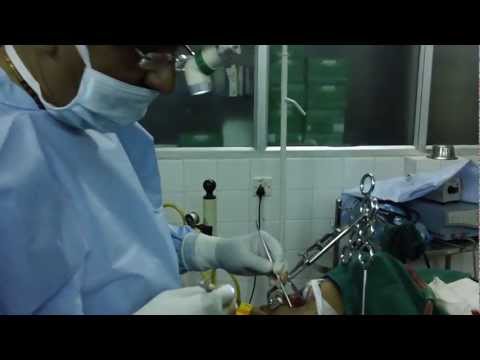
Grommets insertion is normally a quick and simple day-case procedure.
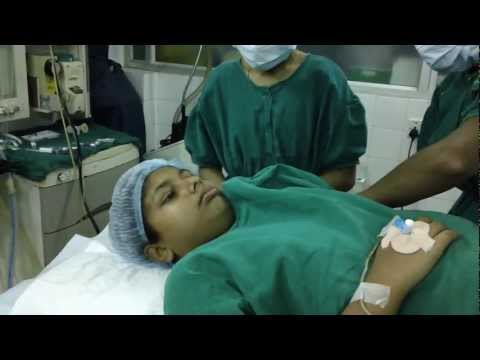
It is very delicate and normally done under general anesthetic (patient fully asleep) the anesthetic is usually given by injection into a vein in the back of the hand, or by gas. To prevent the needle from hurting, a local anesthetic cream is applied about an hour beforehand.
A microscope provides a magnified view of the eardrum. A small cut (myringotomy) is made in the eardrum, and the fluid in the middle ear is sucked out. The cut is like a tiny button hole in the eardrum. Sometimes, if the glue is very thick and sticky, like treacle, a second cut is needed. The second opening allows air in to the middle ear while the glue is sucked out. Sometimes ear drops have to be pumped in to thin the glue in order to suck it out.
The grommet is fitted. It is held in position by the tension of the eardrum gripping it around the waist. The grommet’s shape stops it falling in or out, like a shirt stud in a button hole. If the eardrum is badly thinned, stretched and damaged, it might not have the strength to hold a standard grommet in place. A bigger grommet (long term ventilation tube) might be used in such a case.
Some eardrops are usually applied at the end of the procedure.
If the adenoids are to be removed, this is normally done under the same anesthetic. The adenoids are removed via the mouth.

What happens after the operation

Children recover very rapidly from grommets insertion and should be able to return to school after a day or two.
The hearing normally improves immediately, but don’t worry if there is still some difficulty in the first weeks as it can take time in some cases.
There may be a very slight earache, treated easily with Calpol or paracetamol for older children. There may be slight bleeding from the ear in the first few days. This is normal and nothing to worry about.

Swimming with grommets

No swimming for the first two weeks. After that, surface swimming is allowed without earplugs. Bath water should not be allowed in the ears. The head should not be submerged in the bath. For hair washing, either use earplugs, or a piece of cotton wool dipped in Vaseline to provide a waterproof seal.


When children have a cold or a throat infection the tonsils can become infected and swell up, causing symptoms such as a sore throat, headache and fever. This is called tonsillitis. They can also block the airways, making it difficult for your child to breathe, especially when asleep. This can cause sleep problems such as snoring. In severe cases they can stop your child from breathing for a short time ,known as sleep apnoea.

Diagnosing Tonsils and Adenoid

Examination of the tonsils by looking in the back of your child’s mouth using a light and mirror or a flexible telescope.
Your doctor may recommend a tonsillectomy if your child suffers from frequent bouts of tonsillitis or ear infections, or has breathing problems caused by swollen tonsils.
Xray of the Postnasal space shows enlarged adenoid.

Preop preparation

A tonsillectomy usually requires an overnight stay in hospital. If your child has a cold or infection in the week before the operation, please let your doctor know about it. The operation may need to be postponed until your child has fully recovered.
The operation is done under general anaesthesia. This means your child will be asleep during the procedure. Typically, your child must not eat or drink for about six hours before a general anaesthetic. Often the operation will be planned for the morning, so that your child will only have to miss breakfast.
The surgeon and anaesthetist will usually visit your child before the operation. Please tell them if your child has any allergies, loose teeth or any history of bleeding problems in the family.
You may be asked to sign a consent form. This confirms that you understand the risks, benefits and possible alternatives to the procedure and have given your permission for it to go ahead.

Operation

Most tonsillectomy operations are done in children under 15. The only effective treatment for recurrent and persistent tonsillitis is to have the tonsils removed. The tonsils will shrink in size as your child grows older, so an operation may not be necessary. Painkillers and antibiotics only provide temporary relief and are not used for long-term treatment. A viral infection won’t respond to antibiotics.
The operation usually takes about 30 minutes. There are several methods available for removing tonsils.

Traditional Disection method - a special surgical blade is used to cut out the tonsils. Pressure is applied to stop the bleeding, and dissolvable stitches or heat is used to seal the wound.
Laser Tonsillectomy

Post op period

Your child will be monitored and will need to rest on their side until the effects of the anaesthetic have passed. Your child will be groggy, and may feel or be sick.
Your child may complain of a sore throat, earache and a stiff jaw. Pain relief and antibiotics are usually prescribed for a week .
You should encourage your child to drink and eat as soon as they feel ready, starting with clear fluids such as water or apple juice.
After about 12 hours, a white or yellowish membrane -slough - will appear where the tonsils were. This is nothing to worry about and is not a sign of infection.
Your child will usually be ready to go home the morning after the operation. Before you go home a nurse will give you a date for a follow-up appointment.

Recovering from tonsillectomy

Once home, follow the surgeon’s advice about pain relief. You can give your child painkillers such as paracetamol or ibuprofen syrup .Follow the instructions in the patient information leaflet that comes with the medicine and ask your pharmacist for advice. Do not give aspirin to children under 16.
If your child is prescribed antibiotics it’s important to finish the course.
Get your child to drink plenty of fluids and eat. It’s best to start with soft or liquid foods which are easier to swallow. Giving your child a dose of pain relief half an hour before meals may help make eating more comfortable. Encourage your child to brush their teeth thoroughly, at least twice a day.
Your child should rest for a few days and stay at home to avoid contact with possible infections at school. Also keep your child away from crowded and smoky places, and from people with coughs and colds.
If your child develops any of the following symptoms, please contact your doctor or the hospital immediately if any bleeding from the nose or throat or a high temperature
You can expect your child to make a full and quick recovery once the initial pain has resolved. Complete recovery can take two weeks.

Side effects?

Tonsillectomy is commonly performed and generally safe. However, in order to make an informed decision and give your consent, you need to be aware of the possible side-effects and the risk of complications of this procedure.
These are the unwanted, but mostly temporary effects of a successful procedure, for example feeling sick as a result of the general anaesthetic. Common side-effects include:
• sore throat, earache and a stiff jaw - these side-effects may last for up to two weeks
• bad breath - this usually improves after two to three weeks
This is when problems occur during or after the operation. Most children are not affected. The possible complications of any operation include an unexpected reaction to the anaesthetic, excessive bleeding or infection. Antibiotics are usually prescribed to help prevent infection.
Specific complications of tonsillectomy are rare but include:
• bleeding within 24 hours - your child may need to go back into theatre to have it stopped
• bleeding four to seven days after the operation (secondary haemorrhage) - this can be the result of an infection
• damage to the teeth or jaw - this can be caused by the instruments used to keep the mouth open during surgery
• chest infection and breathing problems - there’s a risk blood and tissue from the operation may get into the throat and down into the lungs